

~ Secrets of Diamond Clarity ~
The Odd Truth
What’s meant by “Real World” is not everything is black and white, cut and dry. The same goes with diamond clarities. The diamond grading scale was invented and perfected by GIA. GIA is the only lab, outside of AGS, that adheres to strict grading practices so that your diamond has real value. In other words if someone could just say your diamond was a flawless diamond without any guidelines to follow, and your neighbor could say the same thing about her diamond, then basically diamonds would lose their value. When it comes to diamonds, the more rare something is, the more valuable it is.
This is the problem in the “real world” of diamond grading. Many diamond wholesalers do not like the strict guidelines that GIA uses. They “feel” their diamond should be graded higher, thus making their diamond more valuable and making them a better profit when they sell it. Out of this thinking new diamond grading labs were born. These new grading labs are much more loose on their diamond grading. They made their own guidelines and follow them, and then try and pass them off using GIA’s grading system.
Know About Different Grading Labs
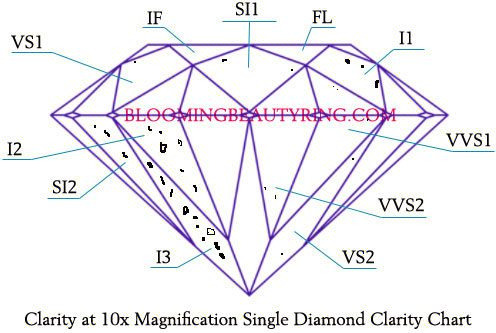
This is what the advanced diamond clarity chart is for. It will show you what clarity grading level the diamond you’re looking at needs to be to match the pictures below. As a rule of thumb what GIA says your diamond it, it is. Period! No questions asked. Not by your insurance company, not by any online or offline jewelry store. GIA is the foremost authority when it comes to diamond grading and they are not argued with. However others can be argued with because as a rule of thumb in the diamond world diamonds that are graded by any other gemological lab other than GIA or AGS can be off by at least 1-3 grades. So that diamond you’re looking at that's graded by, say, EGL Israel that reads SI1 clarity on the certification will most likely be, according to most experts in the jewelry industry, as well as GIA, an I1 diamond possibly a high I2.
| 10x Magnified | Naked Eye | Clarity / Description | To find this Clarity |

|
|
IF / FL - Internally Flawless / Flawless Free From internal blemishes. Usually requires a microscope with more than 20x power to see anything remote. The most rare and most prized of the clarities. Absolutely eye clean. The rarest clarity you will find. |
|

|
|
VVS1 - Very Very Slight Included 1 Inclusions are very difficult to locate under 10x magnification. You could never tell the difference between IF and VVS1 with the naked eye. Absolutely eye clean. |
|

|
|
VVS2 - Very Very Slight Included 2 Inclusions are very difficult to locate under 10x magnification. You can not tell the difference between IF, VVS1, or VVS2 with the naked eye. Absolutely eye clean. |
|

|
|
VS1 - Very Slight Included 1 Inclusions are difficult to locate under 10x magnification but easier than IF, VVS. You can not tell the difference between a VS and VVS with the naked eye. Absolutely eye clean! |
|

|
|
VS2 - Very Slight Included 2 Inclusions are difficult to locate under 10x magnification but easier than IF, VVS, VS1. You can not tell the difference between a VS and VVS with the naked eye. Absolutely eye clean! |
|

|
|
SI1 - Slight Inclusion 1 Inclusions little harder to see under 10x magnification. Most of the time very clean to the naked eye. SI1's simply offer the most for your money! Your naked eye 99% of the time can not tell the difference between a SI1 and a VVS clarity diamond. |
|

|

|
SI2 - Slight Inclusion 2 Inclusions much easier to see under 10x mag. Inclusions are viewable to the naked eye. Differs from SI1 in the fact that that inclusion in a SI1 diamond 99% of the time can not be seen with the naked eye, where the inclusions in a SI2 diamond, at least in our many years of experience, can be seen around 70% of the time. |
|

|

|
I1 - Inclusion 1 Inclusions and external blemishes are easy to locate under 10x magnification. You can see all inclusions with the naked eye just not as many as you would see with a I2 or I3 clarity diamond. Standard Clarity you would find at many discount stores online and off. |
|

|

|
I2 - Inclusion 2 Inclusions and external blemishes are very easy to locate with the naked eye. If a clean look is what you seek this is not the clarity for you. For the most part every inclusion is clearly visible to the naked eye, not always, but mostly. The only question is how far away you can actually see them. |
|

|

|
I3 - Inclusion 3 Heavy inclusions located with naked eye from far distances. The overall look is rather unpleasing, which is why many I3 diamonds end up being used for commercial purposes, or costume jewelry. |
|
World known for being as strict as GIA, and year after year they help perfect the diamond and gem grading system.
AGS grades using numbers with 0 being flawless all the way to 10 which is considered the worst. You’ll see this reflected in the above chart.
- AGS is second only to GIA.
In the chart above when we say “Any other Lab” we are referring to any and all grading labs that are not GIA, AGS, or EGL-USA. Such as:
- EGL International
- EGL Israel
- IGI
- AGA
EGL-USA is the same thing as:
- EGL New York
- EGL Los Angeles
- EGL Vancouver
- EGL Toronto
EGL International – refers to all EGL companies that are not located in the U.S or Canada. To make this very clear. EGL-USA is NOT the same thing as EGL-Int. Not even close.
The SI3 Conflict - Pay Close Attention
EGL-USA used to be part of the EGL Company as a whole. But has since separated and operates solely as their own company (EGL USA Group). Because of this there are two EGL corporations. EGL-USA, which is any EGL company located in North America (U.S. and Canada), and EGL International, which is any EGL company located outside North America such as EGL Israel, and EGL Belgium. EGL-USA and EGL-Int. are incredibly different from each other.
EGL International has a reputation for grading very soft, often times their grades are off by two or more grades compared to what GIA, AGS, or EGL-USA would grade. They grade so soft that they came up with a new clarity grade called SI3. SI3 was invented so that diamond wholesalers / dealers could get a better grade instead of being forced to use I1. SI3 is nothing more than a glorified I1. Often times it's as bad as I2. In our 20 plus years in the diamond business, our professional opinion would be to avoid anything that says SI3. GIA, AGS, and EGL-USA do not recognize the SI3 grade. Most insurance companies won't either.
Lab Grown Or Earth Mined DiamondsWhich One Is Right For You?
Both Types Of Diamonds Can Be Equally Beautiful
Blooming Beauty Ring offers both lab grown and earth mined center diamonds. We are not here to push you toward either one. Our goal is to explain the honest advantages and disadvantages of each so you can choose the diamond that is best for you.
The first thing to understand is that both are real diamonds. Both can be equally beautiful, both will last forever, and nobody can tell which one she is wearing simply by looking at her ring.
Lab Grown Diamonds
- Cost substantially less than comparable earth mined diamonds.
- May allow you to choose a much larger diamond, a higher quality diamond, spend less money, or all of the above.
- Are created by people using specialized equipment over a period of days or weeks.
- Do not have the geological rarity of a natural diamond and generally have a weaker resale market.
Earth Mined Diamonds
- Were formed by Mother Nature deep within the Earth, usually billions of years ago.
- Offer natural rarity, ancient history and the tradition many people associate with diamond jewelry.
- Have a more established resale market.
- Cost substantially more, which means the same budget will usually buy a smaller diamond, lower quality grades or both.
Most diamonds of either type should not be considered a financial investment. The better choice is the one that fits your preferences, priorities and budget.